Guides
Candle samples before a bulk order: what UAE buyers check

Before a bulk order, UAE buyers check candle samples for cold and hot throw, a melt pool that reaches the glass, a steady flame without soot, an even fill with a centred wick, and labels or print that hold up in heat and humidity. A sticker-label sample costs AED 100 and a printed-jar sample AED 250.
Both are paid upfront and credited against an order of 300 pieces or more, which makes the sample the cheapest part of a candle order and the only part that can stop a bad one. Three hundred units with the wrong wick, an adhesive that lifts in humidity, or a scent that vanishes when the lid comes off is no longer a production question once the pallet sits in your warehouse. It becomes a write-off you have to explain to someone.
Most published advice on testing candle samples comes from the US and Europe, and it assumes a parcel that never got hot on the way. That does not hold here. A sample box can spend an hour in an open car park in August, and a candle shipped from abroad may no longer be the candle that left the supplier.
We see what buyers do with the samples we send. The orders people regret tend to start the same way: three jars smelled in a row, one burned for forty minutes, approval on a feeling. A short, deliberate test with written notes avoids most of that, and the rest of this guide is that test.
Ask for the right sample set, not the prettiest one
Ask for the size you intend to buy, plus the one next to it. Our jars are 100, 200 and 300 ml, with roughly 25, 35 and 45 hours of burn time, and a 200 ml candle behaves differently from a 100 ml one in the same scent because the jar diameter changes how the wax melts. Approving a 100 ml sample and ordering 300 ml is approving the wrong thing.
Keep the scent list short. Three to five fragrances in one sitting is a sensible ceiling. Our range runs past 150 fragrances in six families, and a buyer who asks for twelve at once cannot rank the last six honestly. A wide retail range needs two or three sessions on different days.
Ask for two jars of your lead scent. One gets burned to the end, one stays sealed as your reference. When a batch lands four months later and someone says the scent changed, that sealed jar is the only evidence either side has.
Ask for the finish and the decoration you will actually order. White graphics on frosted glass, the look ORA chose for 300 developer gifts, read nothing like the same artwork on clear glass, and gold foil shifts between daylight and retail spotlights. The method also sets your timeline: a sticker is about a week after approval, print around the jar is 10 to 14 working days. Gift companies and agencies ordering for a client should settle this early, because their client's approval round sits on top of ours.
Cold throw and hot throw, and where buyers get it wrong
Cold throw is what you smell from the unlit candle, nose over the open jar. Hot throw is what fills the room while it burns. A strong cold throw does not promise a strong hot one: some compositions sit heavy in cold wax and open quietly when heated, some do the reverse.
Four mistakes come up again and again.
The first is smelling several scents back to back. Your nose stops discriminating after a few, and everything after that reads as "nice". Give each one its own window, step out into clean air between them, and write the note before you move on.
The second is judging hot throw too early. Twenty minutes in, the candle has melted a coin of wax and is barely working. Hot throw is a reading you take once the pool has spread, which usually means well over an hour.
The third is testing in the wrong room. An office with lunch in it, a showroom with oud burning, a spot under an AC vent: all of them give a false answer. Other smells compete with the candle, and moving air pulls scent away so the room fills unevenly. Use a closed, air-conditioned room roughly the size of the space the candle will live in, and use the same one every session.
The fourth is testing alone. Scent perception varies between people more than buyers expect, and two or three colleagues scoring the same jar separately beats one opinion, especially for a retail range where you are guessing at someone else's taste. Shortlist from the full fragrance range before the set gets built.
The burn test: what the wax should actually do
Trim the wick to around 5 mm before every burn. Skip it and a good sample can look bad for reasons that have nothing to do with the candle.
Burn in sessions of two to four hours. Thirty minutes teaches you nothing and ten hours overheats the jar.
Watch the melt pool. Within the first two or three sessions it should reach the glass on all sides. A full pool is what releases fragrance, and a candle that never gets there will smell weak no matter how strong the oil is.
A narrow shaft burning down the middle with unmelted wax left around it is tunnelling, and the cause decides whose problem it is. Short bursts only? That is use, and longer sessions fix it. Tunnelling on a correct burn cycle with a trimmed wick means the wick is undersized for that jar diameter, and that goes back to the supplier to fix before you approve anything.
Look at the wick after two or three hours. A small carbon ball at the tip is normal with many wick types. A large mushroom that keeps growing, with a tall flickering flame and black marks climbing the glass, points to a wick running too hot for the jar. Soot with an untrimmed wick or in a draught tells you about the test; soot on a trimmed wick in still air is a reason to reject the sample.
Log the hours against the figure quoted. Nobody needs it to the minute, but a 200 ml jar quoted at about 35 hours that dies at 20 needs explaining before you commit to 300 units.
Our wooden wick at AED 15 extra per candle needs testing on its own merits. It crackles, needs a shorter trim, and sometimes needs a relight in its first minutes. Some buyers love it; some find it fussy as a hotel amenity where nobody on the floor will be trimming anything.
Frosting and shrinkage are the wax, not the fault
Soy wax is a vegetable wax and it crystallises. That shows up as frosting, a fine white bloom on the surface and sometimes up the sides of the glass, more visible over time, in coloured wax, and in clear jars than frosted ones. It changes neither burn nor scent. It is not a defect, and no one selling soy candles can promise you it will never appear.
Wet spots, where the wax pulls away from the glass in patches, are a temperature effect and cosmetic. A small dip around the wick after cooling is normal, as is a surface that sets rough rather than glass-smooth after the first burn.
What does deserve a rejection: chipped or cracked glass, a wick off centre enough to burn against the wall, a wick that moves when you touch it, debris in the wax, a lid that will not seat, fill height visibly different from jar to jar, a scent that is clearly not the one you approved.
Decide in writing, before the order, which cosmetic variations you accept. Clear glass on a shelf deserves a stricter standard than frosted or matte black, where most of this is invisible. Buyers building a range under their own name should put that tolerance into the spec from the start: in private label programmes it belongs next to the artwork and the fragrance list.
The UAE climate is part of the test, and part of the risk
Soy wax softens a long way below its melt point. The inside of a parked car in Dubai in July goes far past anything a finished candle should see, and so does an unconditioned warehouse bay in Al Quoz.
A sample that got heat-cycled on the way to you shows it: the surface re-pooled flat and glossy, the wax drew back from the glass, the wick leans, the top notes are gone, a sticker edge has lifted. None of that is a judgement on the candle itself, so ask for a replacement instead of scoring it.
Handling, which costs nothing:
- Take delivery in the morning and move the box straight indoors.
- Never leave samples in a car, not even for the twenty minutes you think it will be.
- Test in an air-conditioned room at a steady temperature, the same room every time.
- Store spare jars upright, boxed, out of direct sun, at the temperature your stock will live at.
If your own storage runs hot over summer, the stock will go the same way the sample did, and that is a question to settle before the order. For hotels, spas and restaurants the storeroom matters as much as the product, which we cover on the page for hotel and spa candles.
Our candles are hand-poured in Dubai, so a sample that only has to cross the city arrives in the condition it left in. A sample flown in from another country sits in cargo, on an apron and in a van first, so by the time you light it you may be testing a damaged object. Our minimum is 300 pieces per size, and we supply up to 15,000 candles a month, more by agreement; the rest of how supply works is on the candle supplier page.
Labels, print and packaging: the road to the shelf
The candle can be right and the order can still fail on the outside of the jar.
Test the sticker in real conditions, not on a desk. Leave a labelled jar in a bathroom for a few days and another somewhere warm, then look at the edges for lifting and curl. Adhesive that behaves in an office can let go in a spa changing room. A sticker adds AED 5 per piece and is the faster route to market. EURO TECH's 500 candles, for one, carried branded sticker labels on clear glass with bamboo lids.
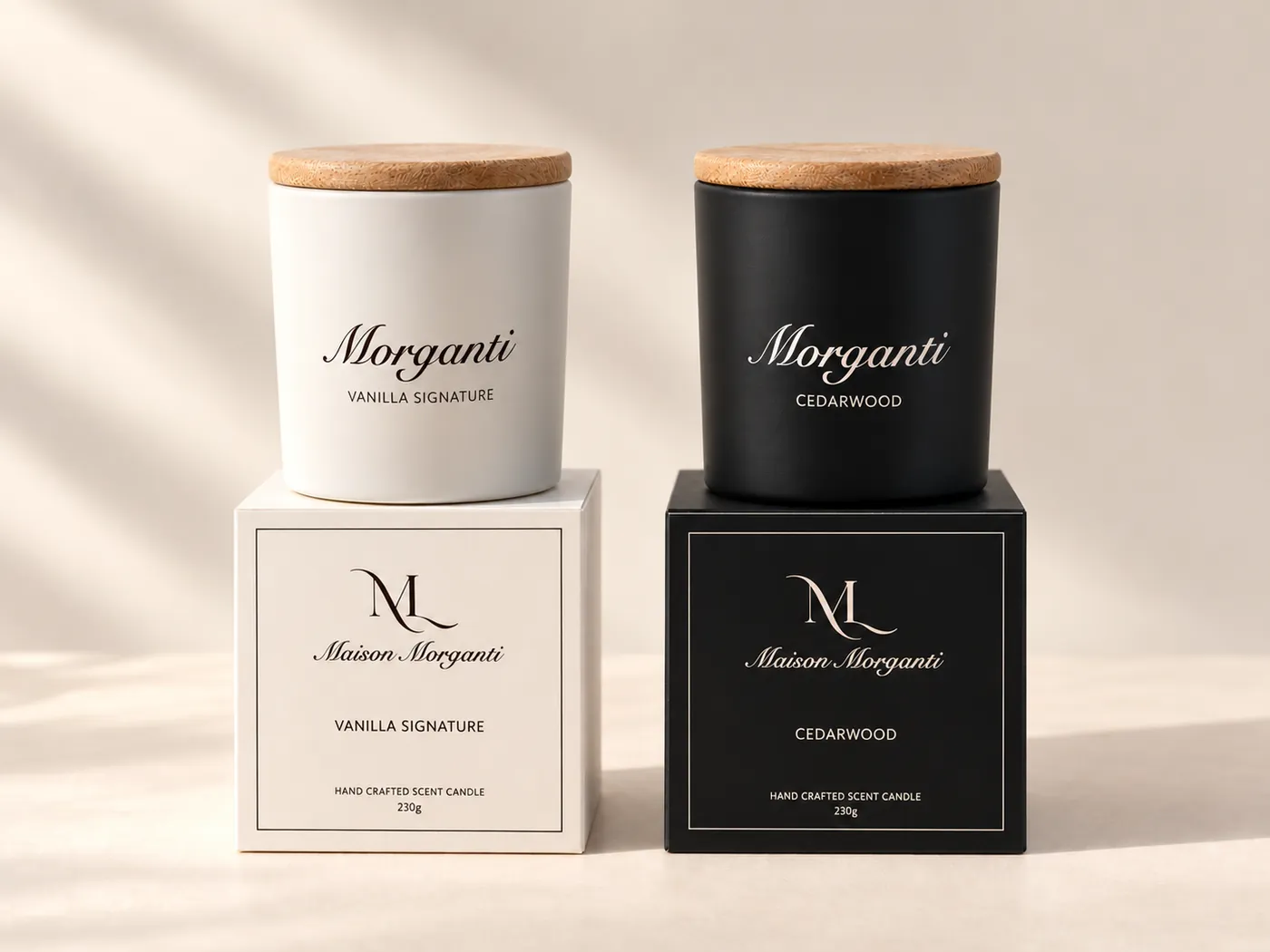
Print around the jar has no edge to lift, so it holds up better through handling and warm storage. It is AED 15 per piece in one colour, from 300 pieces per design, and the minimum sits on the design rather than the scent. One printed jar can therefore carry a whole fragrance range, which is usually the cheaper answer for a retail collection. A brand that wants each scent to look different can still have it: Maison Morganti's retail collection of more than 1,000 candles carries branding specific to each fragrance, with matching printed boxes.
Then rub the print, dry cloth first, then slightly damp. Light pressure should not move it. Look at the artwork at actual size on the real jar too, in daylight and under the lighting your product will sit in. Small type is where screen approval goes wrong.
Handle the outer packaging like freight rather than a gift. Put the jar in the box and shake it, drop it from counter height, stack ten and press down. Our kraft box is AED 5 per piece, a printed box AED 15, a sticker on the box AED 5, a fabric pouch AED 3, and the one that protects best is not always the one that photographs best. If the product goes to a shelf, settle who prints the barcode now rather than after the run.
Worth doing with any supplier, us included: ask in writing what documentation they can issue for your market. From us, on request, that means safety data sheets and a technical data sheet for the soy wax, IFRA conformity certificates for candle use (IFRA Category 12) from our fragrance suppliers, fragrance safety data sheets and an ingredient list for your label. If the goods leave the UAE, agree who handles the paperwork before you order.
A checklist you can walk through by hand
| Check | What you want | Question or reject when |
|---|---|---|
| Cold throw | Clear, recognisable scent from the open jar | Faint, chemical, or not the scent approved |
| Hot throw | Room fills within the first hour or two | Nothing at full melt pool, or an overpowering wall of scent |
| Melt pool | Reaches the glass within two or three proper burns | Tunnels on 2-4 hour sessions with a trimmed wick |
| Wick and flame | Steady flame, small carbon ball, no soot in still air | Heavy mushroom, tall flickering flame, soot on clean burns |
| Glass and fill | Even fill, centred secured wick, lid seats | Chips, cracks, off-centre wick, fill varying jar to jar |
| Label and box | Edges hold in heat and humidity, print resists rubbing | Lifting adhesive, print that transfers, jar loose in the box |
Frosting, wet spots and a rough surface after burning belong in neither column. That is the wax behaving normally.
What one sample set cannot tell you
A sample set answers scent, burn behaviour, jar, decoration and packaging on a handful of units. It says nothing about consistency across 3,000 pieces, how the fragrance reads after three months on a shelf, how 300 boxes travel stacked on a pallet, or how print colour holds across a full run.
So treat approval as two steps. First, the approved sample becomes the reference for the whole production run, so keep a sealed jar from the approved set, signed and dated by both sides, and write the accepted tolerances into the purchase order instead of leaving them as a conversation. Second, compare the run with that jar. Our terms are 50% to start and 50% before dispatch, so if you want to see finished units before you pay the balance, agree that when you place the order. Before dispatch is the cheapest point left to catch a problem.
Numbers to plan against, excluding VAT, from 300 pieces per size: from AED 70 for 100 ml, AED 90 for 200 ml, AED 110 for 300 ml, including the jar (clear, matte black or frosted white; 100 ml in clear only), standard wick, soy wax, a bamboo or metal lid (silver or gold) and one base fragrance. A 200 ml candle with a sticker, a kraft box and a box sticker starts at AED 105, or AED 125 in 300 ml; with one-colour print on the jar and a printed box, from AED 120 for 200 ml and AED 140 for 300 ml. The final price depends on the fragrance, the jar design and the packaging. Volume discounts are 5% from 1,000 pieces, 7.5% from 3,000 and 10% from 5,000. Delivery in Dubai is included, elsewhere in the UAE it is free from 1,000 pieces, and for Saudi Arabia and the rest of the GCC it is quoted on request.
FAQ
What is the difference between cold throw and hot throw?
Cold throw is the scent from the unlit candle with your nose over the jar. Hot throw is the scent the candle puts into the room while burning. One does not predict the other, because heat changes how a fragrance releases. Score both separately and write the notes as you go.
How long should you burn a candle sample before approving it?
Longer than most buyers do. Sessions of two to four hours, wick trimmed to about 5 mm each time, and at least two or three sessions before you decide. Hot throw is only readable once the melt pool has spread, and tunnelling shows up over several burns. To check burn time, log the hours against the quoted figure: roughly 25 hours for 100 ml, 35 for 200 ml, 45 for 300 ml.
Is frosting on soy candles a defect?
No. Frosting is natural crystallisation in vegetable wax, more visible in coloured wax and over time. It affects neither burn nor scent, and no supplier of soy candles can guarantee its absence. If a clear-glass retail look matters, say so early so the jar finish works with it.
How many samples should you ask for before a bulk order?
Three to five fragrances per session, in the size you plan to buy plus the adjacent one, with two jars of your lead scent so one stays sealed as a reference. Beyond that your nose stops giving reliable answers. A sticker-label sample is AED 100 and a printed-jar sample AED 250, both paid upfront and credited against an order of 300 pieces or more.
How should samples be stored and shipped in hot weather?
Indoors, upright, boxed, out of sun, at a stable temperature. A sample left in a car or an unconditioned store will deform, pull away from the glass and lose top notes, and after that you are testing the journey rather than the product. If one reaches you in that state, ask for a replacement instead of scoring it. A sample that only has to cross Dubai has far less of that journey to survive than one flown in from abroad, which is the main reason local testing gives a cleaner reading.
Tell us the sizes, the fragrances and the decoration you are weighing up, and we will put together samples around your actual decision rather than a generic set. Send the brief here or message us on WhatsApp at +971 55 281 9889, and the cost of the samples comes off an order of 300 pieces or more.