Product guide
Candle burn time by jar size: what 25, 35 and 45 hours mean
A 100 ml jar burns for roughly 25 hours, a 200 ml jar for 35, a 300 ml jar for 45. Those are the figures on our specification sheets, and they are the numbers a buyer should be working from, because burn time is what the end customer judges three weeks after the purchase, long after the packaging has been thrown away.
Burn time also decides which format belongs in which programme. A hotel amenity and a distributor's hero SKU are two different jobs, and the hours are what separate them. Get the format wrong and you either overpay for wax nobody burns or you hand out a candle that dies before the guest notices it.
Our soy wax candles are hand-poured in Dubai and we supply up to 15,000 of them a month, more by agreement, so most of this is arithmetic we do weekly for chains, distributors and corporate gifting companies. Below is the logic we walk buyers through before a purchase order is signed.
What burn time actually measures
Burn time is the total number of hours a candle stays alight from first flame to the point where the wick can no longer sustain a melt pool. It is not a single uninterrupted session. Nobody burns a 300 ml candle for 45 hours straight, and the National Candle Association's own care guidance says a candle should not be burned for more than four hours at a time, with the wick trimmed to about 6 mm before each session.
So 45 hours is roughly eleven sensible sessions. For a retail buyer that is the number worth translating into shelf language: a 300 ml jar is about a month and a half of evening use, a 100 ml jar is two or three weeks. That framing does more for sell-through than the word "premium" on a shelf talker.
For a large order, remember that burn time is an estimate under normal conditions, not a warranty; a supplier who quotes it to the decimal is selling confidence rather than data. The figure is also only comparable between suppliers when the wax type and the fill mass match.
Where 25, 35 and 45 hours come from
Jar capacity is the volume of the glass, not the weight of the wax inside it. Every jar is poured short of the rim, so a 200 ml jar holds meaningfully less than 200 ml of wax. This is where most buyers misread competing quotations: two suppliers can both write "200 ml" and deliver jars with different fill levels, different wax masses and therefore different hours.
The industry rule of thumb is roughly 7 to 9 hours of burn per ounce of wax, which is where our three numbers land. It is a planning guideline, not a measured constant, and the actual result moves with the wick, the fragrance load and how the candle is used.
| Format | Approx. burn time | Base price, AED per unit |
|---|---|---|
| 100 ml | 25 hours | from 70 |
| 200 ml | 35 hours | from 90 |
| 300 ml | 45 hours | from 110 |
Base prices apply from 300 units per size, include a base fragrance and exclude VAT. The final number per unit depends on the jar, the branding and the packaging you add on top; the full add-on list sits on our pricing section.
Notice that the hours do not scale in a straight line with the price. Going from 100 ml to 300 ml costs about 57 percent more per unit (AED 110 against AED 70) and buys 80 percent more hours (45 against 25), which is one of the cleaner value comparisons in this category. The larger format also carries branding better, because a 300 ml jar gives a print area a 100 ml jar simply does not have.
Wax and wick: what moves the number
The candles we supply are poured from soy wax, and that choice has practical consequences for a wholesale order. Soy burns at a lower temperature than paraffin, which generally means a longer burn from the same mass of wax and a cooler jar in the customer's hand. It is also softer, which matters enormously in this climate, and more of that in a moment.
The wick does the rest of the work. A wick that is too large for the jar diameter burns hot, eats wax quickly and can leave soot on the glass; one that is too small tunnels, leaves a ring of unburned wax against the wall and wastes a third of what you paid for. Wick selection is matched to jar diameter, wax type and fragrance load, and it is tested per format rather than guessed.
Wooden wicks are available on request. They change the character of the burn and the sound, and they need their own test round in a given jar, which is why we treat them as a project decision rather than a running option.
Fragrance load also counts. Heavier oils change how the wax melts, so two candles from the same mould with two different fragrances will not give identical hours. We quote a single figure per format because a spec sheet with fifteen footnotes helps nobody, but if a specific fragrance behaves differently in testing we say so before production.
What the Dubai heat changes
Soy wax softens at temperatures a Dubai summer reaches easily, and every buyer moving volume through this market eventually learns this the hard way. The candle that spends an afternoon in a parked van or a week on an uncooled mezzanine will not look like the one that was packed for dispatch.
What shows up on the shelf: frosting on the surface, wet spots where the wax has pulled away from the glass and gone back, a soft or uneven top, and in bad cases a candle that has slumped and reset around a leaning wick. None of it is dangerous and most of it is cosmetic, but a retail buyer is selling a surface, and a customer who sees a mottled top assumes the product is old.
For stock moving through the UAE and the GCC, store it in air conditioning, not in a warehouse that is only cooled during office hours. Keep pallets off loading docks and out of vehicles during the middle of the day, particularly between June and September. And keep the display away from direct sun through glazing, because a shop window in Dubai will do to a candle in a week what a warehouse does in a month.
Burn behaviour changes in heat too. A candle burning in a room at 30°C with a ceiling fan overhead will finish faster and less evenly than the same candle in a cooled room, which is worth mentioning to a hospitality client who plans to use them on an outdoor terrace.
Delivery within Dubai is included on every order, elsewhere in the UAE delivery is free from 1,000 units, and for Saudi Arabia and the other GCC countries it is quoted on request; for summer shipments the timing of the handover is part of the conversation, not an afterthought.
Choosing the format for your programme
Retail chains and distributors. The 200 ml jar at 35 hours is the working default and usually the best margin-per-shelf-facing. It holds a 360° print comfortably, it sits at a price point shoppers accept without hesitation, and it is large enough to feel like a gift. Many chains run 200 ml as the core line and add 300 ml as a gift-box SKU for the fourth quarter.
Corporate gift programmes. Here the recipient's reaction on day one carries the budget, and 200 ml is where perceived value meets sensible cost per head. For executive or client-facing gifts, 300 ml with a printed box reads unmistakably as a considered gift. Our work for property developer ORA sits in this band: white geometric branding on frosted glass, shown in the project gallery.
Hotels, spas and restaurants. These are consumables with a replacement cycle, so hours per dirham is the whole equation. A spa treatment room burning a candle six hours a day gets about a week from a 300 ml jar, a few days from a 100 ml. Work out the replacement interval you want, then pick the format that matches it, rather than picking a size and discovering the reorder frequency later.
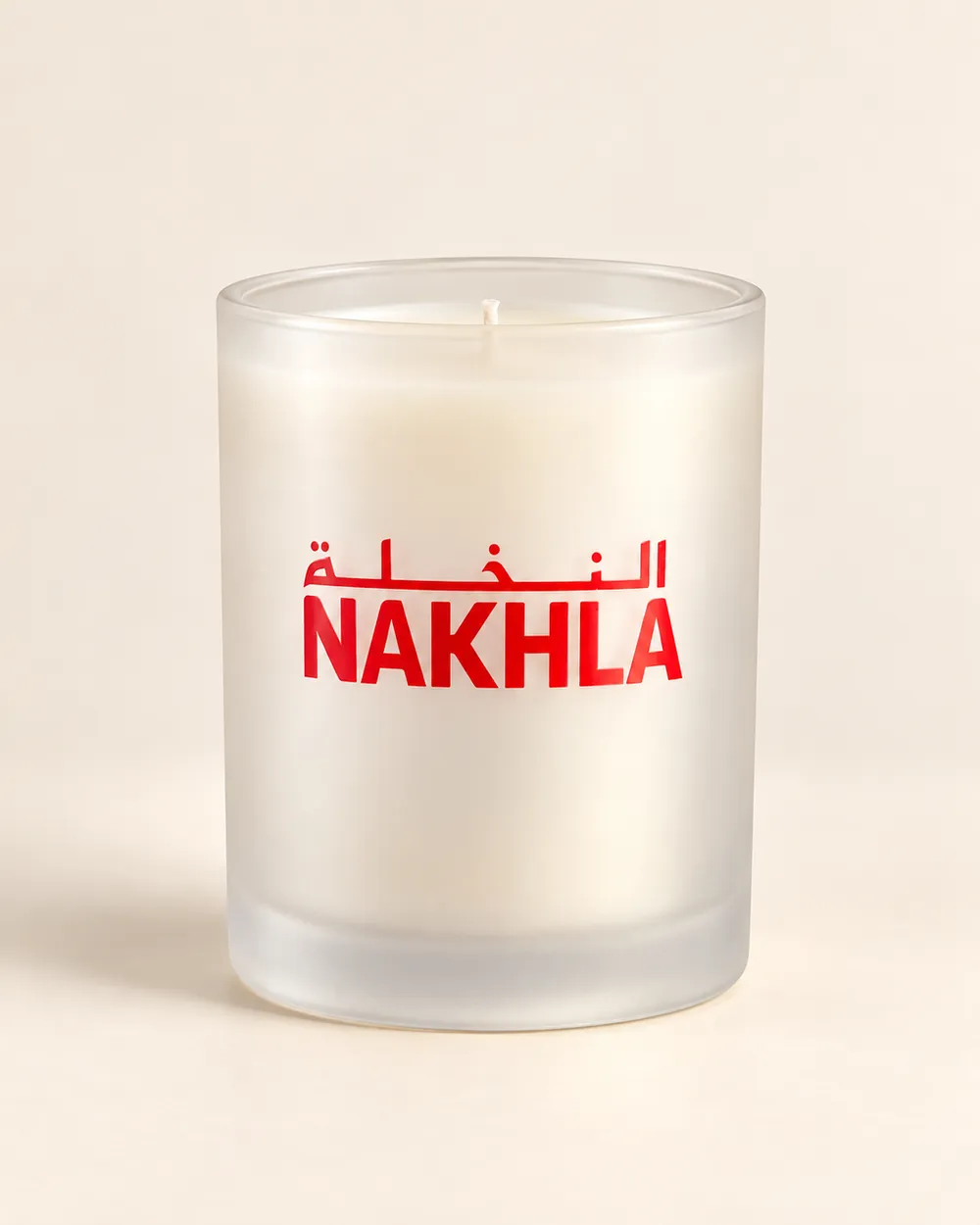
Seasonal and event runs. For Ramadan and Eid sets, exhibition giveaways or seasonal campaigns, 100 ml at 25 hours does the job at the lowest unit cost and is the easiest to pack in volume. NAKHLA's exhibition giveaway ran on this logic: red branding on frosted glass, handed out on the stand rather than kept as a shelf item.
Different fragrances can share a single printed design: a six-scent Ramadan collection on one artwork still counts toward the same run, which is how a 300-unit printed minimum covers a whole line instead of one scent. The mechanics of that sit in our guide to private label candles in the UAE.
What to check with a supplier before a large order
Before signing for thousands of units, ask for these in writing:
- Wax mass per jar in grams, not just jar capacity in millilitres. This is the only figure that makes two quotations comparable.
- Wax type and whether the blend is 100% soy or a soy-paraffin mix.
- Wick type and the fact that it was tested in that exact jar, not a similar one.
- Burn time stated as an approximate range under normal room conditions, and what conditions that assumes.
- Certificates, if your buyer or your market requires them. Ours are available on request and we confirm scope before the order rather than after.
Then test it yourself. Light a sample, note the start time, burn it in four-hour sessions the way a customer would, and check the melt pool after the first burn: it should reach the glass wall within two to three hours. If it does not, the wick is undersized and the stated hours are optimistic.
Our samples are AED 100 with a sticker label and AED 250 with printing on the jar, paid upfront and credited in full against an order of 300 units or more. Use them. A sample burn costs you an evening and settles an argument that would otherwise happen after 5,000 units are on a pallet.
Lead times after approval are one week for sticker labels and 10 to 14 working days for printing on the jar, with payment at 50% to start and 50% before dispatch. If you know your format and your quantity, send the brief through our quote form and we will come back with a costed specification.
FAQ
How long does a 200 ml candle burn?
About 35 hours in total, spread across sessions rather than in one sitting. At four hours per session, the maximum recommended by the National Candle Association, that is roughly nine evenings of use. A 100 ml jar gives about 25 hours and a 300 ml jar about 45.
Can I order candles with a specific burn time?
You choose the burn time by choosing the format, since the hours follow the wax mass. Our three standard formats cover 25, 35 and 45 hours, and larger sizes are available on request for bigger programmes. If your programme is built around a replacement interval, for example a spa that wants a one-week cycle, tell us the interval and we will recommend the format rather than the other way round.
Does the heat in the UAE affect how a candle burns?
Yes, in two ways. Stock stored above normal room temperature can soften, frost or pull away from the glass, which is cosmetic damage a retail buyer pays for in returns. And a candle burning in a hot or draughty room finishes faster and less evenly. Air-conditioned storage and shaded display solve most of it, and we plan summer deliveries around vehicle heat.
Which format works best for a corporate gift programme?
200 ml for volume programmes covering employees or broad client lists, 300 ml with a printed box for executive and partner gifts. Both read as a real gift; the 100 ml is better suited to exhibitions and seasonal handouts where unit count is high and cost per head is tight. We cover the full decision in our guide to corporate gift candles in Dubai.
How do I know a stated burn time is honest?
Ask for wax mass in grams alongside the millilitre figure, then burn a sample yourself in four-hour sessions and time it. A candle that fails to reach a full melt pool on the first burn will tunnel and will never deliver the hours on the sheet, whoever printed them.